








Multi-LLM Consensus Architecture for Cell Type Annotation in scRNA-seq Data
mLLMCelltype is an R package that leverages various large language models (LLMs) for automated cell type annotation in single-cell RNA sequencing data. The package implements a multi-LLM consensus architecture where multiple LLMs collaborate through structured deliberation that aims to improve annotation reliability by combining multiple model predictions.
The mLLMCelltype paper was published online in Communications Biology on June 8, 2026.
Key Features
- Multi-LLM Consensus Mechanism: Combines predictions from multiple LLMs to reduce individual model biases
- Structured Deliberation Process: For controversial clusters, LLMs engage in collaborative discussion across multiple rounds, evaluating evidence and refining annotations together
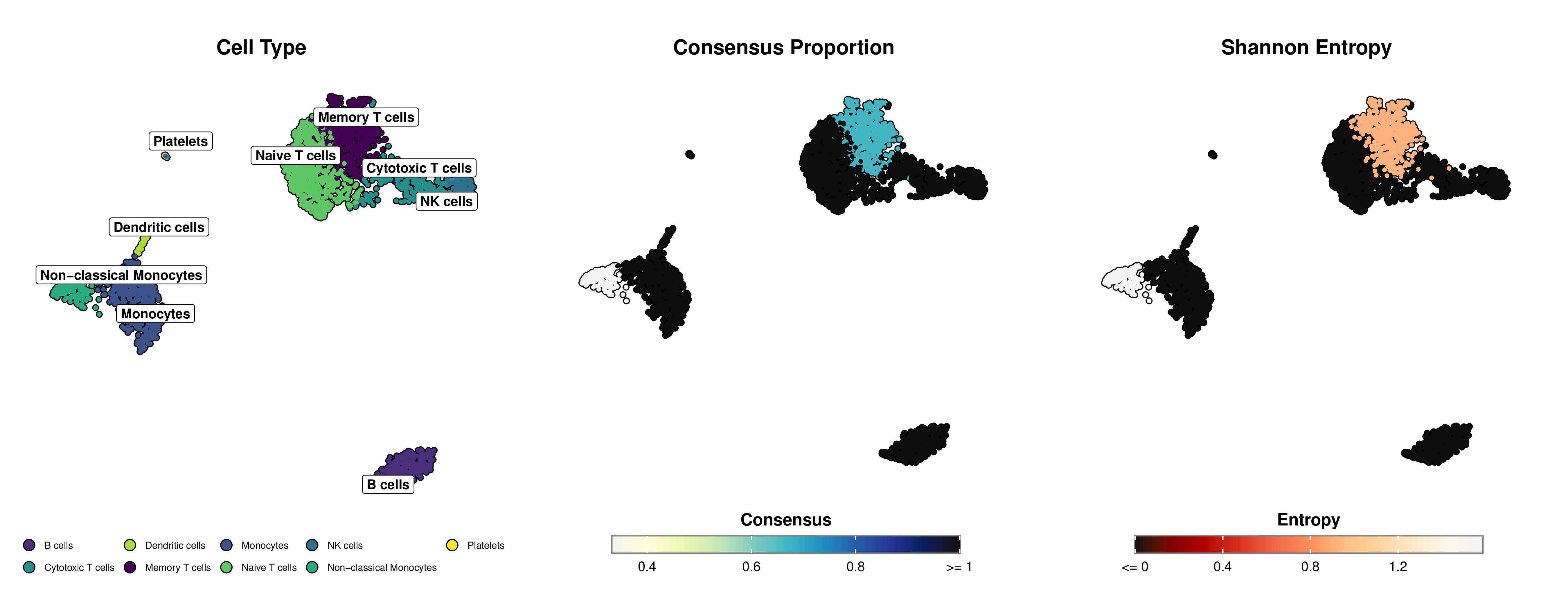
- Uncertainty Quantification: Explicitly quantifies annotation uncertainty through consensus proportion and Shannon entropy
- No Reference Dataset Required: Does not rely on pre-existing reference datasets, can annotate various tissues and species
-
Support for Multiple LLM Providers:
- OpenAI (GPT-5.5, GPT-5.4, GPT-5.4-mini)
- Anthropic (Claude Opus 4.7, Claude Sonnet 4.6, Claude Haiku 4.5)
- Google (Gemini 3.1 Pro Preview, Gemini 3 Flash Preview, Gemini 3.1 Flash-Lite)
- X.AI (Grok 4.3)
- DeepSeek (DeepSeek V4 Flash, DeepSeek V4 Pro)
- Qwen (Qwen3.6 Plus, Qwen3.6 Flash, Qwen3.6 Max Preview)
- Zhipu/Z.AI (GLM-5.1, GLM-5, GLM-5-Turbo)
- MiniMax (MiniMax M2.7, MiniMax M2.7-highspeed)
- Stepfun (Step 3.5 Flash, Step 3)
- OpenRouter (access to Meta Llama, Mistral, Microsoft, Perplexity, Cohere, and more)
- Seurat Integration: Can directly use Seurat’s FindAllMarkers() output as input
Quick Start
# Install the package
devtools::install_github("cafferychen777/mLLMCelltype", subdir = "R")

# Load the package
library(mLLMCelltype)

# Set API keys
Sys.setenv(ANTHROPIC_API_KEY = "your-anthropic-api-key")
Sys.setenv(OPENAI_API_KEY = "your-openai-api-key")
Sys.setenv(GEMINI_API_KEY = "your-gemini-api-key")

# Use multiple models for annotation
models <- c(
  "claude-sonnet-4-6",
  "gpt-5.5",
  "gemini-3.1-pro-preview"
)

# Run multi-model annotation
results <- list()
for (model in models) {
  provider <- get_provider(model)
  api_key <- switch(provider,
                   "anthropic" = Sys.getenv("ANTHROPIC_API_KEY"),
                   "openai" = Sys.getenv("OPENAI_API_KEY"),
                   "gemini" = Sys.getenv("GEMINI_API_KEY"))

  results[[model]] <- annotate_cell_types(
    input = pbmc_markers,
    tissue_name = "human PBMC",
    model = model,
    api_key = api_key
  )
}

# Create consensus using interactive consensus annotation
api_keys <- list(
  anthropic = Sys.getenv("ANTHROPIC_API_KEY"),
  openai = Sys.getenv("OPENAI_API_KEY"),
  gemini = Sys.getenv("GEMINI_API_KEY")
)

consensus_results <- interactive_consensus_annotation(
  input = pbmc_markers,
  tissue_name = "human PBMC",
  models = models,  # Use the models defined above
  api_keys = api_keys,
  controversy_threshold = 0.7,
  entropy_threshold = 1.0,
  max_discussion_rounds = 3,
  consensus_check_model = "claude-sonnet-4-6"
)
Citation
If you use mLLMCelltype in your research, please cite our paper:
@article{yang2026llmconsensus,
  author = {Yang, Chen and Zhang, Xianyang and Chen, Jun},
  title = {Large language model consensus substantially improves the cell type annotation accuracy for scRNA-seq data},
  journal = {Communications Biology},
  year = {2026},
  doi = {10.1038/s42003-026-10420-8},
  url = {https://doi.org/10.1038/s42003-026-10420-8},
  publisher = {Springer Nature}
}
You can also cite this in plain text format:
Yang, C., Zhang, X., & Chen, J. (2026). Large language model consensus substantially improves the cell type annotation accuracy for scRNA-seq data. Communications Biology. https://doi.org/10.1038/s42003-026-10420-8
Learn More
Please check our documentation to learn more about mLLMCelltype.